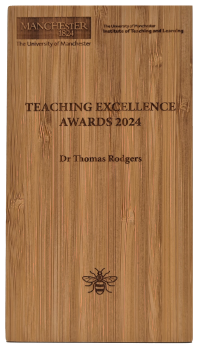
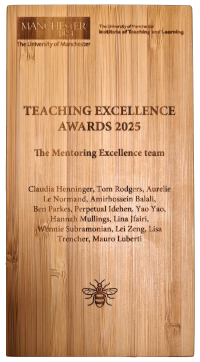
I am Thomas Rodgers, a Professor of Engineering Education at the University of Manchester. I am also a chartered fellow of the IChemE. I was the Discipline Head of Education for Chemical Engineering (2019-2022) where I was responsible for strategic and operational leadership of the accredited undergraduate and postgraduate programmes within the department.
I am involved with teaching courses and also teaching research. This page provides some resources for some of these areas.
I am a member of the the University of Manchester’s Chemical Engineering Education Innovation Research Group (CEEI).
A complete list of my publications can be found here.
Teaching Resources
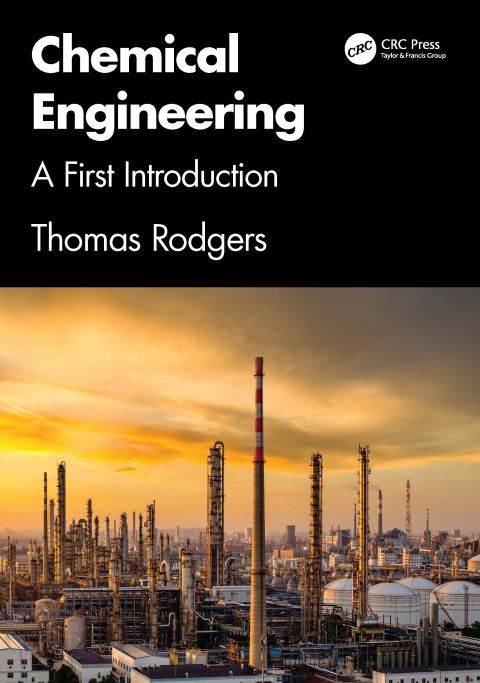
Chemical Engineering: A First Introduction
This textbook introduces new chemical engineering students to the key subjects taught in most undergraduate Chemical Engineering degrees: Process Engineering Fundamentals, Chemical Thermodynamics, Process Fluid Flow, Process Heat Transfer, and Chemical Reaction Engineering.
This is a course covering hydrostatics, flow with ideal fluids, applications of Bernoulli’s equation, momentum balances, friction losses, pumps, and open-channel flow.
This is a course covering mole balance for reactors, extent of reaction and conversion in reactors, rate laws and stoichiometry, determination of rate law parameters, temperature dependence of reaction rates, and multiple reactions.
This is a part of a course, and the topics taught by me covered particle shape and size, single particle motion in fluids, settling and settlers, centrifuges, and cyclones.
This course provided an introduction to molecular dynamics coding, including a backround to molecular dynamcis, molecular interactions, practical spects of molecualar dynamics, and analysis of molecular dynamics simulations.
This course provided a brief introduction to soft matter systems and common methods used to simulate them at a variety of scales. These notes are a bit rough and need some updating, so there maybe errors.
This course was a short refresher course for students looking at mass and energy balances around a chemical reactor. A mass and energy balance problem is provided.
Over the past number of years I have been responsible for the development of training and mentoring for GTAs. This has involved looking at training courses and also support for AFHEA applications. More information can be found at the link below,
I therefore provide the Lab Based Teaching Section of FSE60004 Teaching Practice & Assessment Strategy for the University of Manchester New Academics Programme.
Teaching with Rich-Media
This is a project looking involvement of rich-media within teaching and how students use these materials. The main focus of this has been on videos and student use of these; however, there has also been the creation of some web-apps, e.g.
This is a project looking at alternative assessment types and how student feedback can be improved. One key area is looking a peer marking and feedback.
I have therefore provided the following training and development courses at the University of Manchester:
FEPSS7005 Teaching for Researchers: Assessment and Feedback
FSESS8202 FSE GTA Marking and Feedback
FSESS8204 FSE GTA Teaching Skills
FSESS8210 FSE GTA Support for HEA fellowship applications